Handcrafted in Aveyron, the historic home of the Laguiole knife Free laser engraving: 22 fonts and 156 symbols to choose from Delivered by DHL International Certificate of authenticity, pouch and Laguiole guide included One knife, one cutler, up to 166 operations by hand
Embers of the Steppe: Laguiole Knife in Red Mammoth Molar – Damascus Blade – Chiseled Bee – Mosaic Pins

1889€

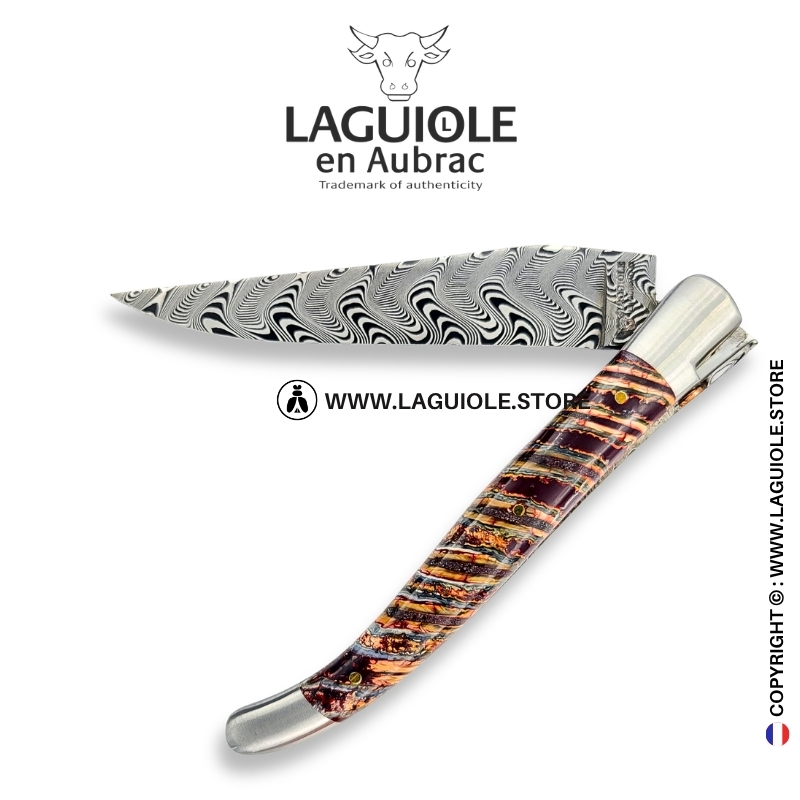
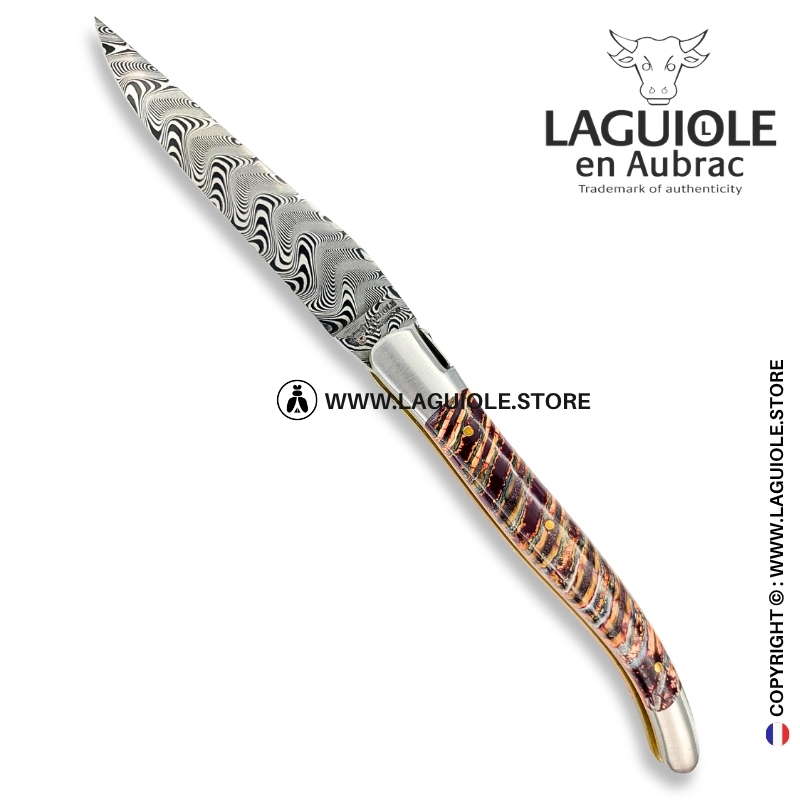
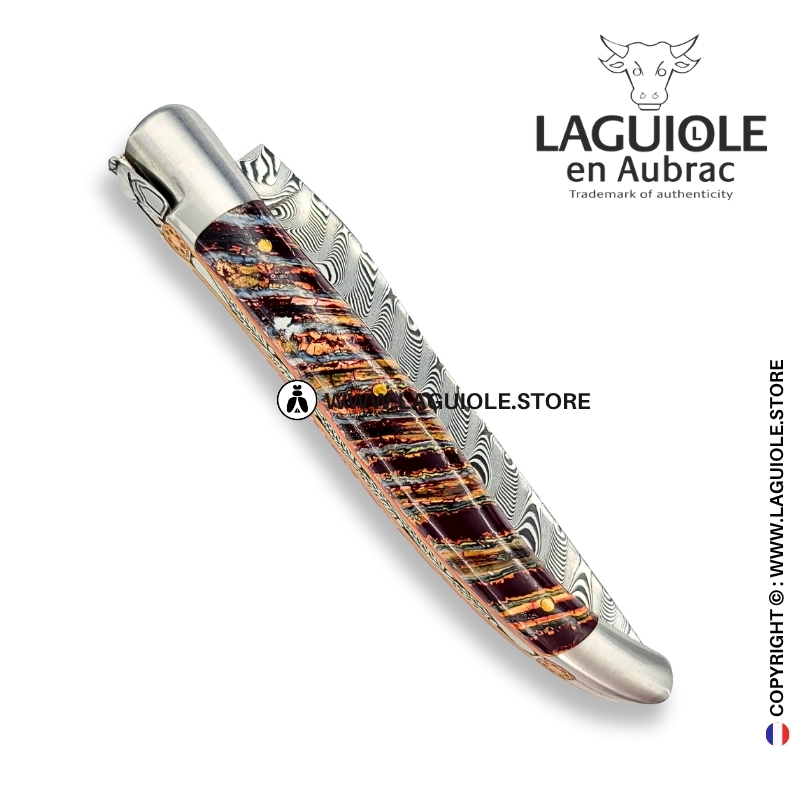
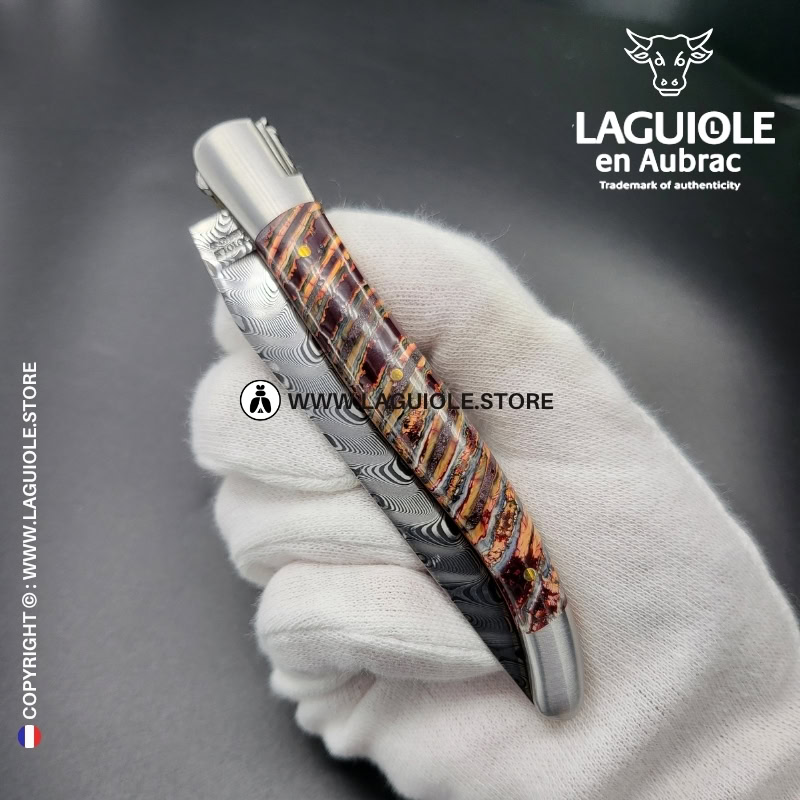
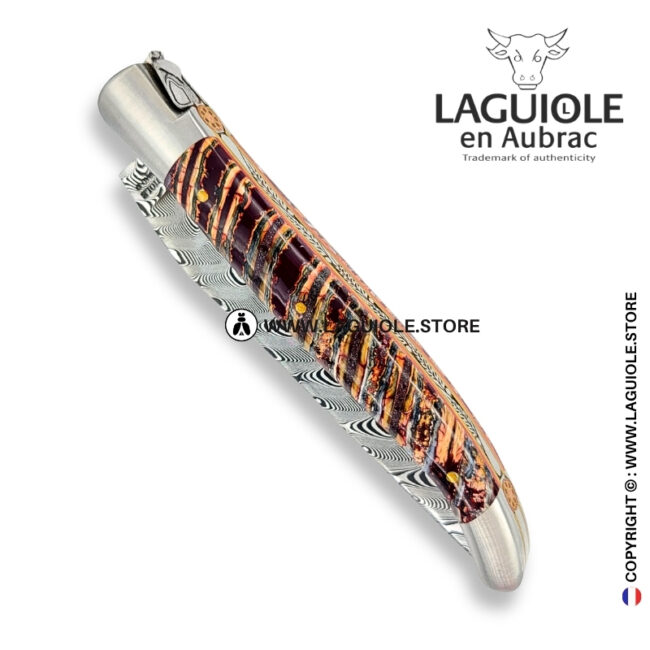
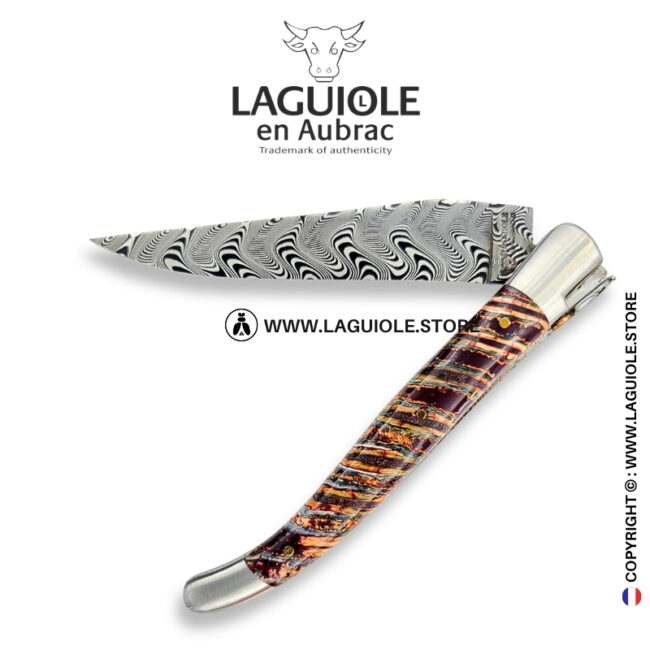
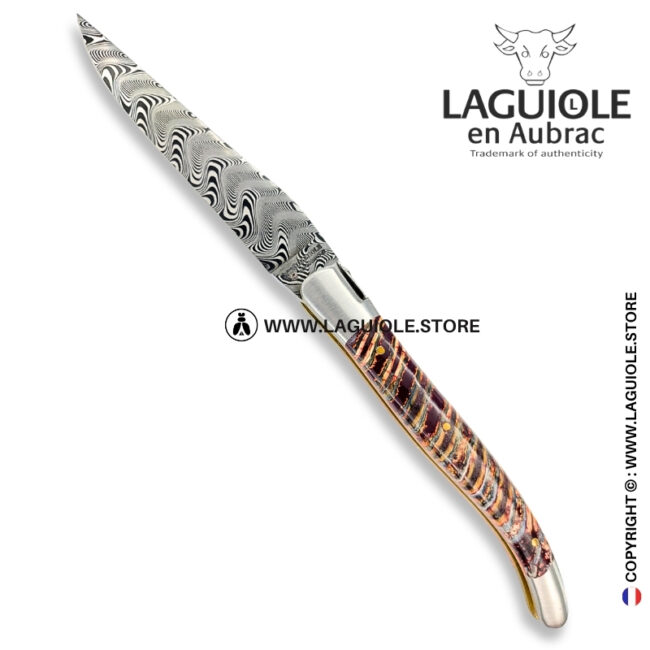
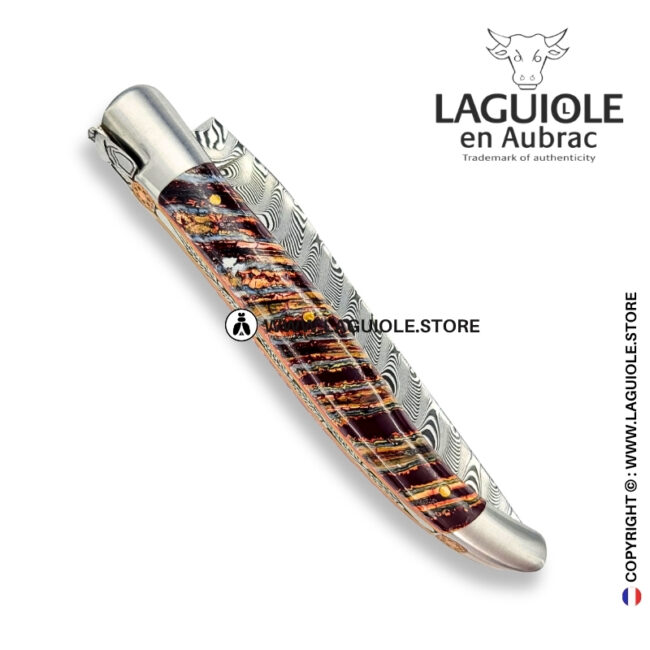
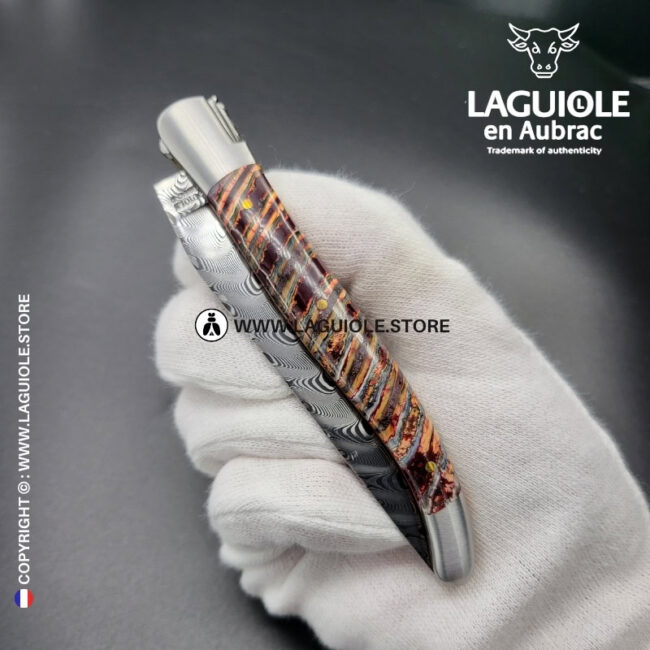
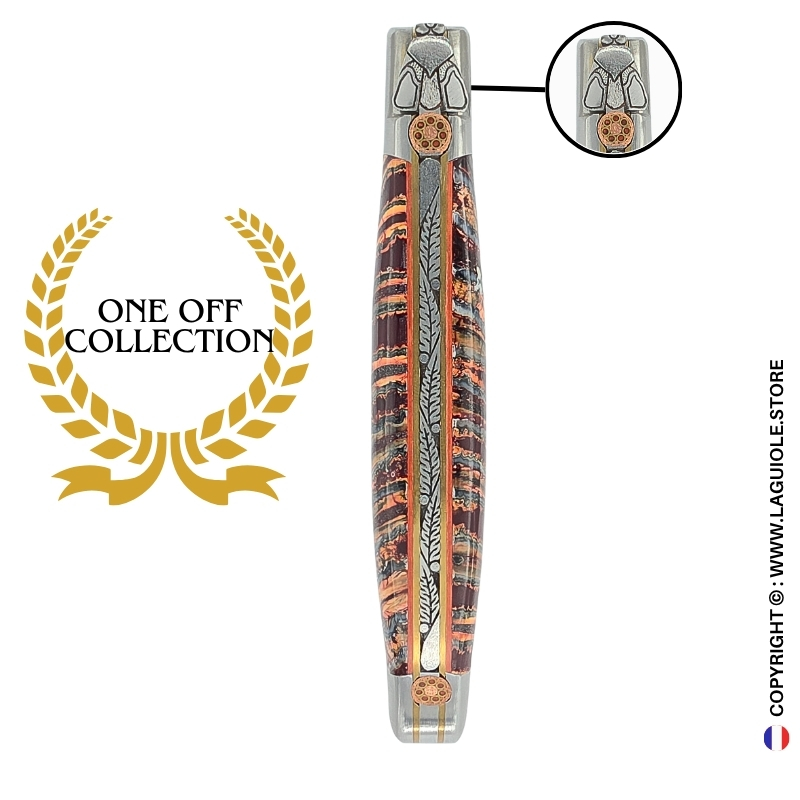
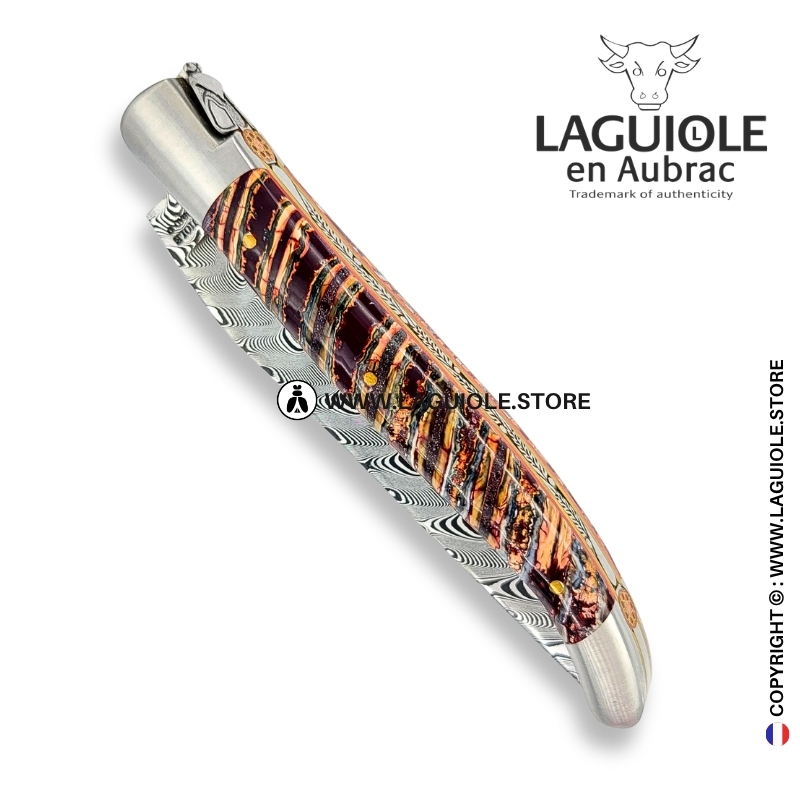
Stripes of red, orange, and charcoal that smolder across the handle, cut from a tooth that lay for millennia in frozen ground: that is where “Embers of the Steppe” gets its name. Only one exists, and a single cutler at the Laguiole en Aubrac manufacture took it through every stage of its making. Sawing the mammoth molar open has laid bare the stacked plates of the tooth, and they cross the handle on a slant in tight, wavy bands: deep red, the orange of live coals, cream, charcoal, and here and there a patch of blue-gray. Every band is a growth layer the animal built up and the earth later mineralized. The red was brought in during stabilization, and it makes each layer stand out in relief.

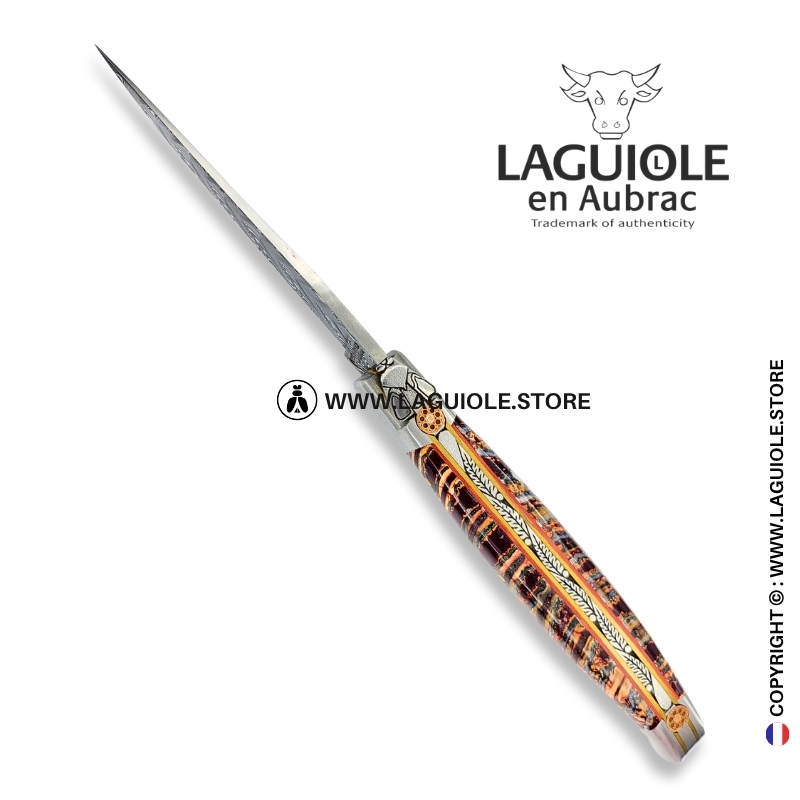
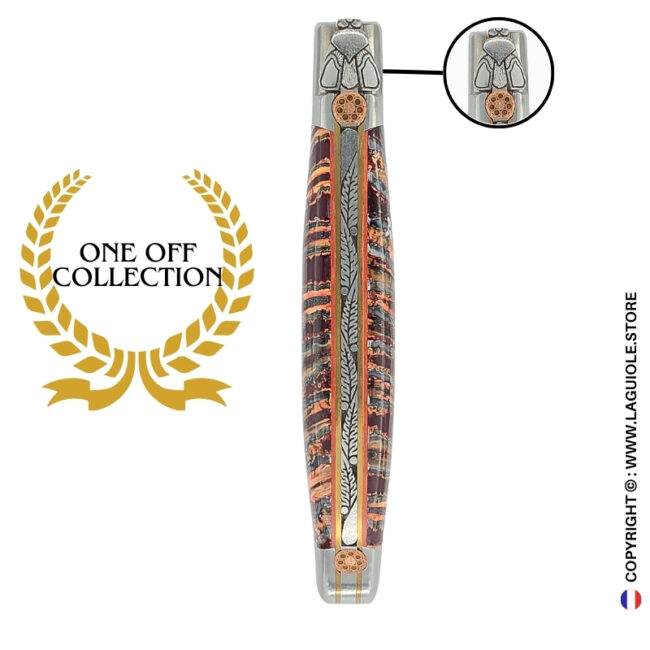
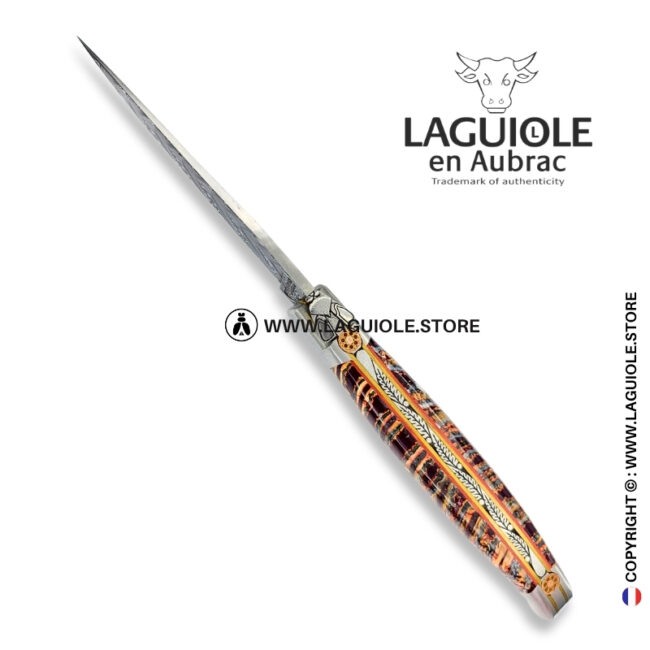
The bee on top is broad and settled. Its wings are split into clean panels inside a polished rim, around a finely stippled body, and a two-lobed head completes the outline with restraint. Right beneath it, a red spacer slips in between molar and brass liner. Seen edge-on, the handle lines up four materials in the space of a few millimeters: fossil, red, the warm yellow of brass, then the steel of the spring.

A chiseled wheat ear travels the whole length of the spring without a break, its nested chevrons laid like the barbs of a feather and dotted with tiny raised beads. At either end, a mosaic pin is inlaid in the bolster, a small disc where a circle of red dots surrounds a copper heart, as fine as a jeweler’s setting. The damascus blade completes the composition with concentric ripples, dark and light sheets of steel born from the layering of the metal and brought out by etching.

“Embers of the Steppe” will speak to collectors who like each material on a piece to arrive with a past of its own. Molar banded like a banked fire, a damascus blade, mosaic pins at both bolsters, red spacers, and brass liners make for an unusually intense knife, built to be used every bit as much as admired.
Protect your Damascus blade
A Damascus blade is an exceptional, hand-forged piece. A fitted case protects it from knocks, moisture and scratches, and preserves its beauty over the years.
Wrapping and message card
Sheath & box
Damascus blades cannot be engraved: their patterns come from layers of steel forged together, and the laser would damage this unique grain.
✓ Order today for an estimated delivery by Friday, November 13
SKU: LEA PU - 1212 MOL MAM RGE - BR STEP - DAMAS Category: Category: One-of-a-Kind Laguiole Knives

Created in 1829 in the small village of Laguiole for local farmers, this knife has risen to become one of the most celebrated in France, distinguished by its emblematic bee, a symbol of prestige and quality.

Laguiole en Aubrac Knife in Mammoth Molar with Damascus Blade

Two laminated materials share this knife. On the handle, mammoth molar shows the plates of the fossil tooth as close, slanting bands where deep red gives over to orange, cream, and charcoal, framed by brass and a thin red spacer.

An unbroken wheat ear is chiseled along the spring, and each bolster holds a mosaic pin with a ring of red dots around a copper core. Dark and light ripples curve through the damascus blade in a concentric figure that no other blade will share.

  • 4.7" (12 cm) handle in mammoth molar. Red spacers, brass liners and rivets.
  • Exclusive model: one of a kind, never to be reproduced.
  • Pattern-welded damascus blade.
  • Chiseled bee, spring chiseled with a wheat-ear pattern. Two mosaic pins set into the bolsters.
  • Made entirely by hand by a single cutler.
  • Cotton pouch and numbered certificate of authenticity included.
  • 14-page guide to the craftsmanship charter of the authentic Laguiole included.
  • Lifetime warranty against manufacturing defects.

Fossil from the ice and steel from the forge, tied together by a thin seam of red and brass: "Embers of the Steppe" carries cold and heat in one knife. It is made once, with no second edition to come. If mammoth molar and damascus on the same piece is what you have been hunting for, this one should not get away.

Tilt the handle and the molar's slanted bands smolder from deep red to ember orange, broken by cream and charcoal, above a fine red line that runs along the brass. On the spring, the chiseled wheat ear stays sharp and beaded from end to end, while a mosaic pin glows at each bolster. At the head rests a wide, calm bee with paneled wings and a finely stippled body.

embers of the steppe: laguiole knife in red mammoth molar – damascus blade – chiseled bee – mosaic pins

Two layered materials meet on this knife, and both took their time. The handle comes from a mammoth’s molar, a tooth that grew plate by plate over the animal’s life and then spent millennia locked in the frozen soil of the steppe. The saw finally opened it onto tight, rippling bands set at an angle, where deep red passes into ember orange, cream, and charcoal, with brief flashes of blue-gray. In the hand it reads like a book of stacked time, page upon page.

Facing it, the damascus blade unrolls its concentric ripples, dark and light sheets created by layering the steel and revealed by etching. Tooth and blade follow the same logic, layer over layer, only on wildly different clocks: what the steppe needed millennia to deposit, the steel acquired under the hammer. And just as no two mammoth molars are alike, no damascus blade ever repeats another’s figure.

Between the two, nothing is left to chance at the joins. A brushstroke-thin red spacer divides the fossil from the brass liner, and the warm tone of the brass answers the glowing bands of the handle. The chiseled wheat ear runs along the spring from end to end, and at each extremity a mosaic pin set into the bolster shows its circle of red dots around a copper core, like two seals pressed at the close of a letter. Everything about “Embers of the Steppe” rests on that meeting of frost and forge, with a few millimeters of red and brass to reconcile them.

Mammoth Molar

This handle is cut from the cheek tooth of a woolly mammoth, an extinct grazer whose remains are still dug out of permanently frozen ground in Siberia, Canada, and Alaska. Inside, it is built with startling complexity, dentin plates folded into enamel and bound together with cementum, and a mammoth wore through several sets of these teeth in its lifetime. Sawn and polished, that architecture appears as tight, wavy bands that have never been drawn the same way twice.

As found, the material is porous and fragile, which is why it is impregnated with resin in a vacuum chamber before anyone shapes it. Stabilization gives the molar density and durability and protects it from rot. It is also the source of the red: left untreated, molar runs only from cream to brown. The finished surface is cool at first contact, with a mineral polish that wood never gives. On "Embers of the Steppe," the red bands cut diagonally across the handle and pick up the color of the spacers.

Damascus Blade

Damascus starts as a stack of dissimilar steels that the forge welds into one bar, which is then stretched and folded again and again until it counts several dozen layers. Nothing here is printed on top: the figure is the metal's own grain, going all the way through the blade, and etching makes it visible because the acid bites each steel to a different depth.

The result is a play of ripples, sheets, and moiré, and no blade repeats the one before it. Here the concentric figure echoes the strata of the molar, so the two laminated structures talk to each other along the whole knife. Care is simple: wipe the blade after use and keep it dry. Under the light the figure never settles, calm when the blade lies flat, deeper and rolling as it tilts, and you soon catch yourself turning it between your fingers just to watch it shift.

Red-tinted mammoth molar, a forged damascus blade, and mosaic pins rarely share a single knife, and in this exact figure they exist nowhere else. If real depth of time and material is what you are after, claim it before another collector does.

mammoth ivory illustration
damas blade

You may also like…

✓ In stock - Delivery by Friday, November 13
-39%
Original price was: 46€.Current price is: 28€.
✓ In stock - Delivery by Friday, November 13
-39%
Original price was: 36€.Current price is: 22€.
✓ In stock - Delivery by Friday, November 13
-39%
Original price was: 36€.Current price is: 22€.
✓ In stock - Delivery by Friday, November 13
-39%
Original price was: 46€.Current price is: 28€.
✓ In stock - Delivery by Friday, November 13
-39%
Original price was: 36€.Current price is: 22€.
✓ In stock - Delivery by Friday, November 13