
All Laguiole folding knives
Laguiole knives with corkscrew
1099€
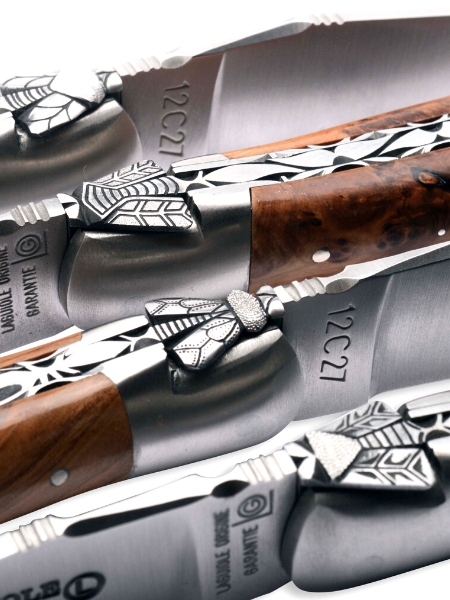
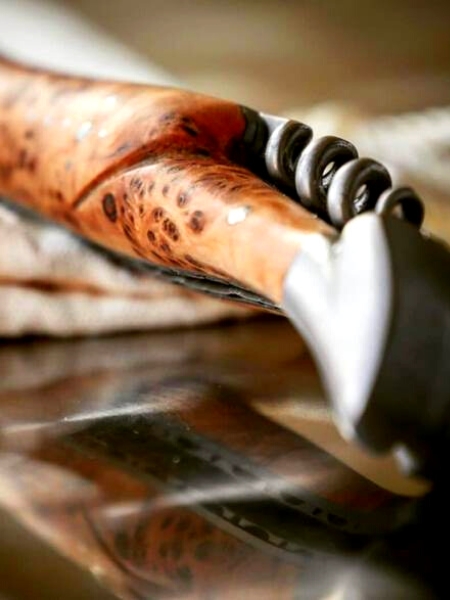
The Shadow Weave Laguiole is a unique piece, entirely hand-crafted by the most skilled cutlers at the Laguiole en Aubrac workshop. Its handle in blackened poplar burl has a powerful visual presence: numerous knots filled with resin create an irregular, animated pattern where shades of black and grey respond to one another. The stabilisation and coloration of the wood give it a singular depth, somewhere between organic material and mineral appearance.
The stainless Damascus blade displays the typical waves of this style of forging. The clearly visible patterns provide an elegant contrast to the dark sobriety of the handle. This Damascus steel offers both character and practicality, giving the knife an immediately recognisable signature.
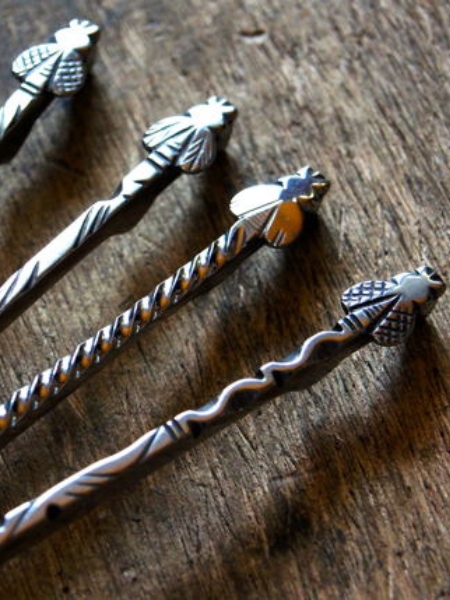
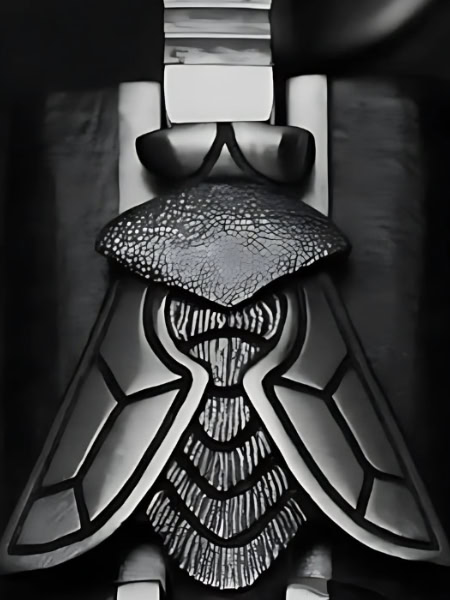
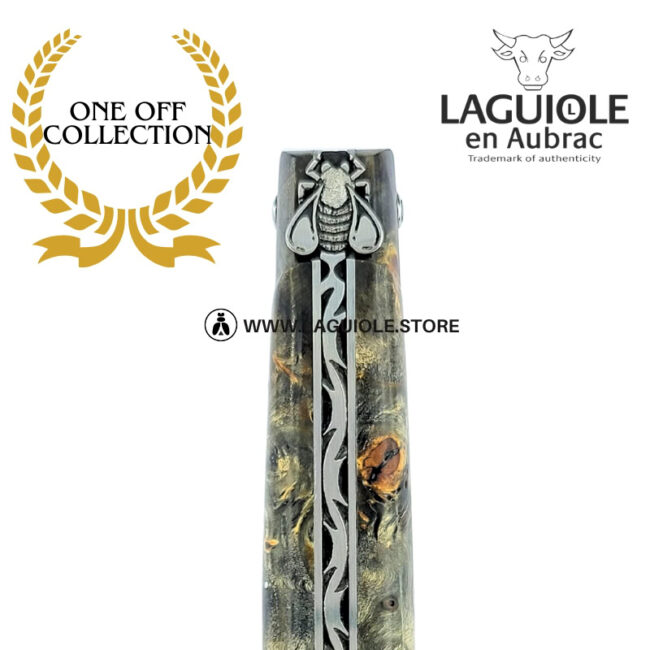
The bee takes on an almost spider-like silhouette. Its body is carved deeply, creating pockets of shadow that bring the overall shape into relief, while head and wings are worked in a more understated way. This balance between strong engraving and simplicity reinforces the knife’s personality.
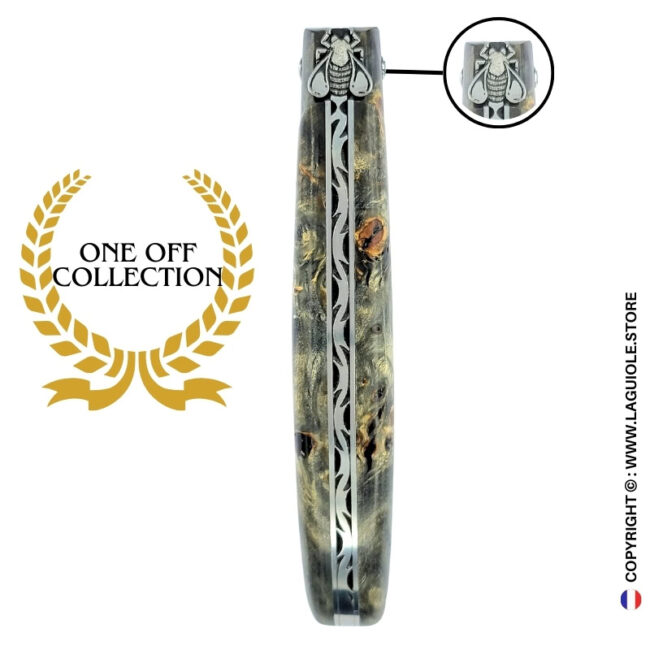
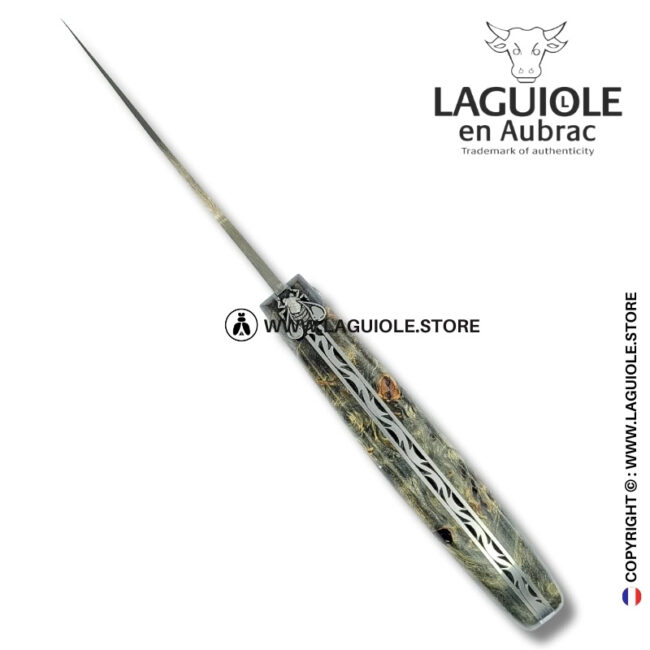
The backspring is evenly chiselled from bottom to top, yet deliberately modest, in keeping with the overall design: refined enough to catch the light, but always measured.
Shadow Weave is a knife with a cool, controlled aesthetic, far from any flamboyance, yet rich in detail for those who take the time to look closely. It is aimed at Laguiole enthusiasts who appreciate knives with strong character, where dark wood, an expressive Damascus blade and a singular bee come together in a coherent whole—discreet, but hard to forget.
This unique piece has been sold


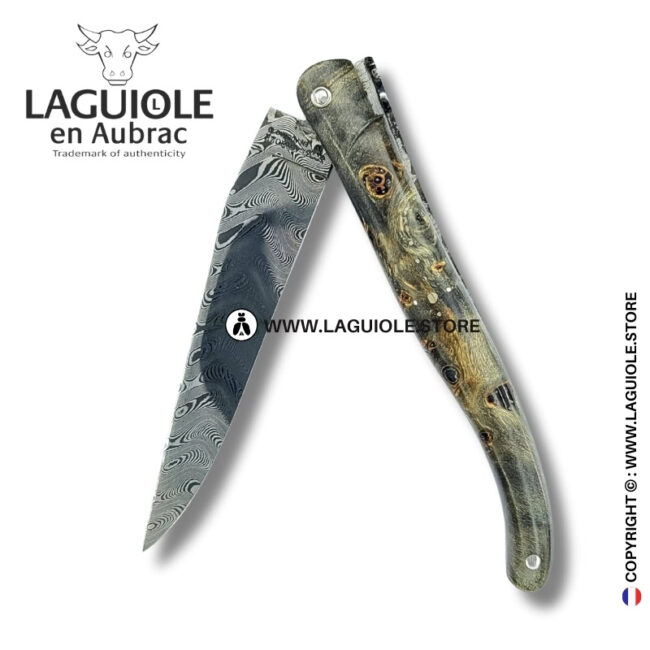
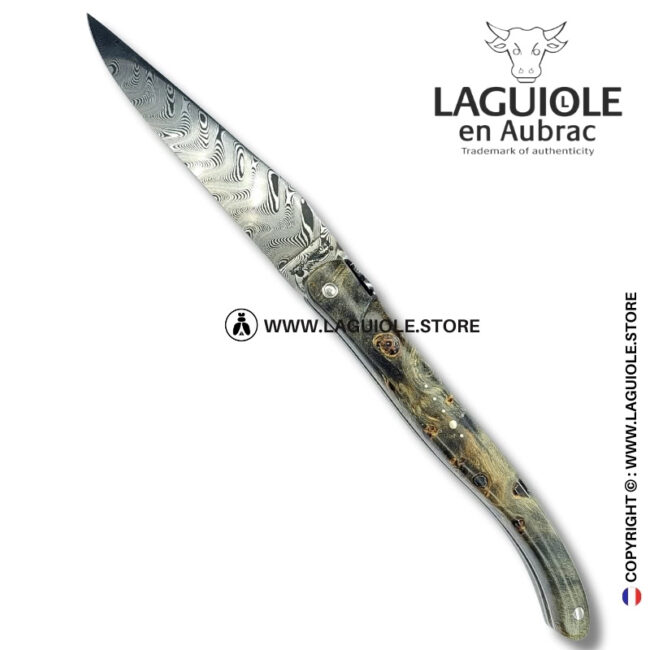
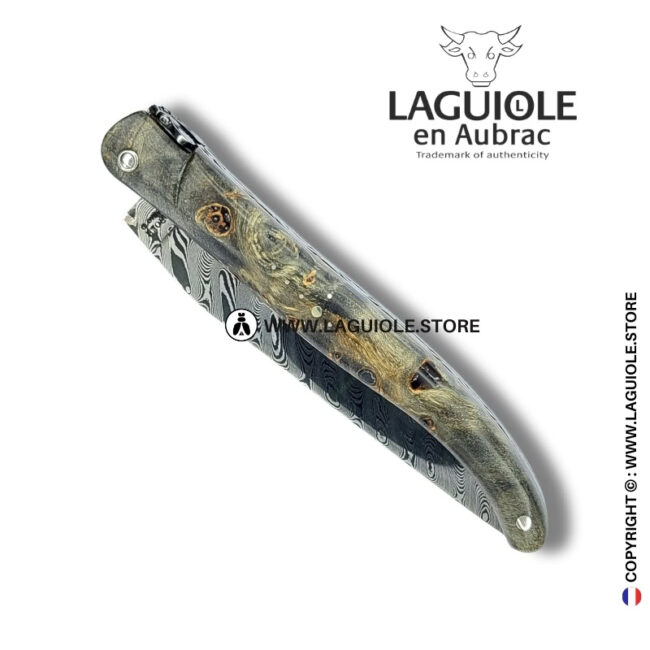
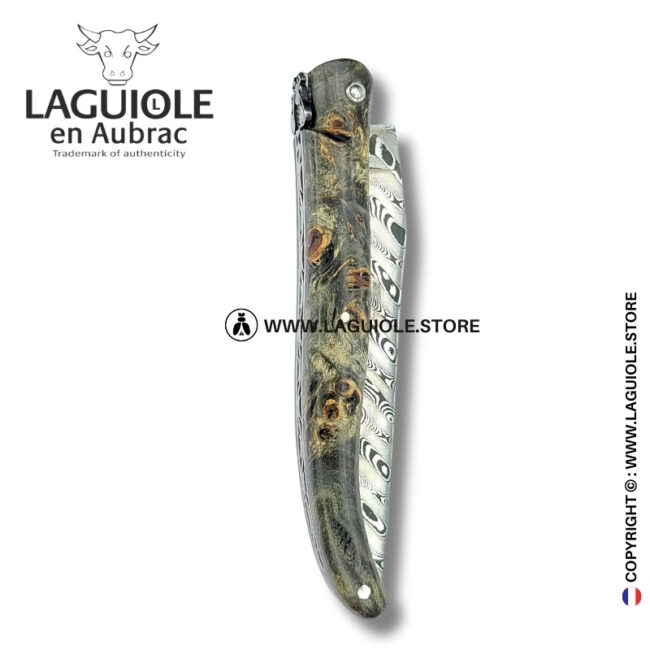
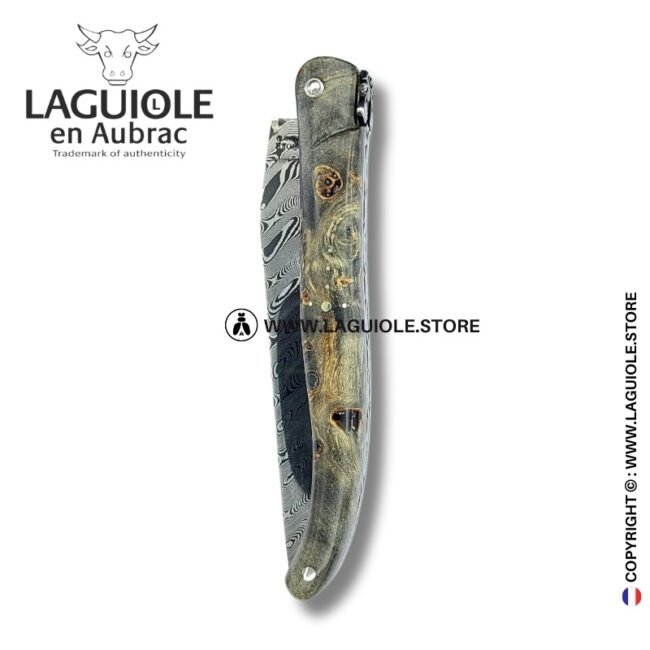
“Shadow Weave” has the quiet presence of a knife made for the night. Its full handle in blackened poplar burl, marked by resin-filled knots and deep veins, moves between dark grey and dense black. The material suggests charred wood as much as cold stone, as if light had been deliberately kept at a distance. In contrast to this brooding handle, the stainless Balbach Damascus blade unfolds its characteristic wave patterns, like a clear current cutting through the dark.
At the top, the bee takes on an almost arachnid silhouette. Her deeply carved body digs shadows into the metal and makes the more restrained head and wings stand out in relief. The backspring is decorated with regular motifs that recall honeycomb cells – sometimes appearing full, sometimes empty – continuing this play between solid and hollow, light and shade.
“Shadow Weave” is a Laguiole of cool, controlled character – designed for those who prefer discreet depth over dazzling effects.
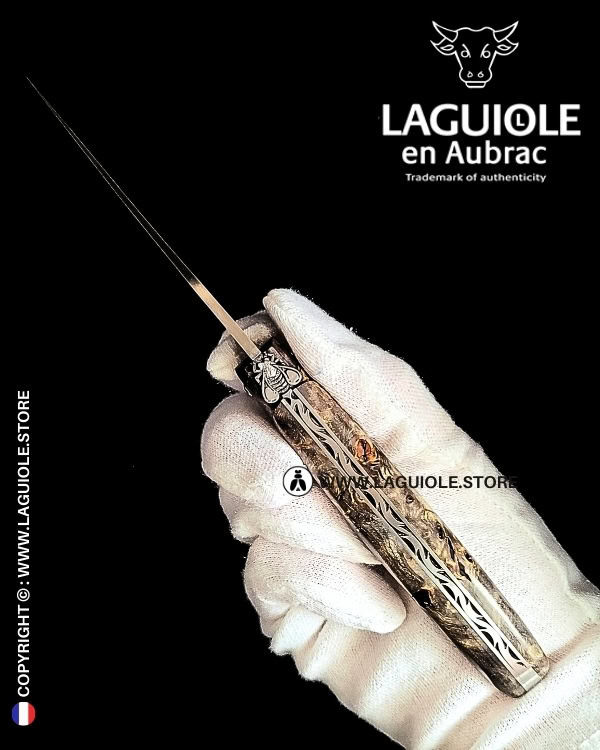
Shadow Weave feels like a knife forged to cross mountain passes at night, where the wind blows with no one to witness it. The handle in blackened poplar burl, deeply marked by resin-filled knots, shifts between black and grey. Dark veins, scars in the wood and lighter patches come together to form a surface that feels almost mineral, like rock smoothed by years of weather.
The stainless Damascus blade, with its distinctive rippling pattern, cuts through that darkness. Its surface seems to carry the drawing of a cold current, a deep stretch of water where light only passes through for a moment before vanishing again. Between the two, the knife finds its balance: a dense, shadowed handle and a blade alive with reflections.
At the top, the bee leaves behind its usual softness for a more unsettling presence. Its shape leans toward the arachnid: the body, carved deeply into the steel, digs shadows that make the head and wings—more simply worked—stand out. It clings to the spring like a creature to its rock, keeping watch over the passage. The backspring itself is chiselled from base to tip with controlled restraint: worked just enough to catch the light, never so much as to become ostentatious.
Shadow Weave doesn’t try to seduce with color or exuberance. It speaks instead of silence, cold stone and steep paths. It is a knife you can imagine in the hand of a lookout standing at the edge of a darker world, halfway between reality and the far-off lands of fantasy.
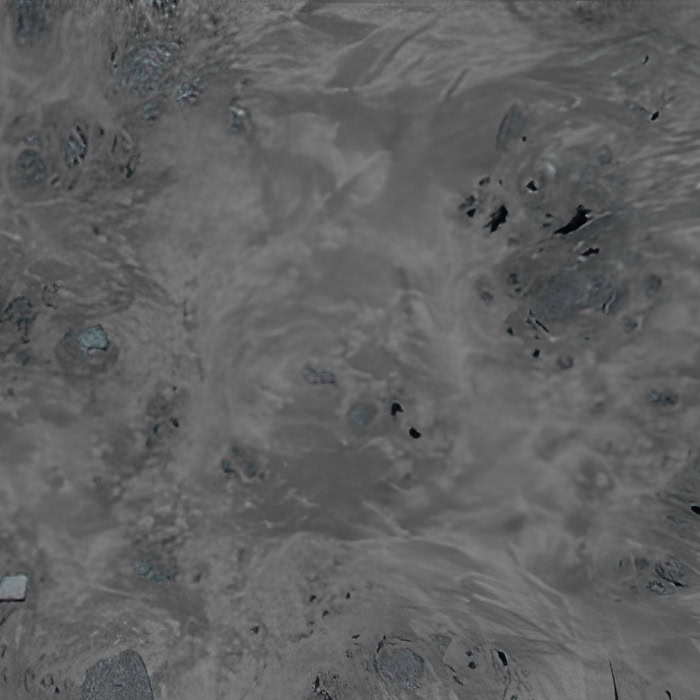
Poplar burl is a singular wood, shaped by knots, swirls and irregular zones that create an abundance of natural patterns. Blackened here through a carefully controlled dyeing process, it reveals shades ranging from deep grey to charcoal black, with an almost mineral feel. The wood calls to mind dark rock, burnt timber or forest shadows frozen in the grain.
Resin-filled knots and a very pronounced grain create a subtle play of contrasts: some areas catch the light, while others remain deliberately muted. Each block of blackened poplar burl reveals its own unique drawing of hairline cracks, marbling and veins, giving the handle striking visual depth – a perfect match for a character piece like “Shadow Weave.”
This dark colour is not natural, but the result of a stabilisation and dyeing process carried out deep within the wood. It enhances durability while giving the material its cool, contemporary tone. A satin polish completes the work, offering a smooth surface animated by discreet reliefs – where traditional craftsmanship meets a distinctly nocturnal aesthetic.


Leather Sheaths & Sharpener


Leather Sheaths & Sharpener

Leather Sheaths & Sharpener

Leather Sheaths & Sharpener

Leather Sheaths & Sharpener

Leather Sheaths & Sharpener




• Made in France, in the historic area of origin.
• Engraving and shipping carried out on the day of the order.
• Deliveries to France, European Union, and internationally.
• Delivery within 48h in EU. 4 days to USA with DHL Express.
• Provided with: certificate of authenticity, 14 page manual of genuine Laguiole knives, protective case.
FREE LASER ENGRAVING
Laser engraving on the blade is an innovative technique that combines art and technology to enhance and personalize a knife. Choose from 6 fonts and 12 symbols.

Laguiole FOLDING KNIVES
Discover our selection of Laguiole en Aubrac folding knives, a staple of French artisanal cutlery. These high-quality pocket knives, combining elegance and practicality, are the result of traditional craftsmanship and unique expertise in knife making.
All Laguiole Folding Knives
Our models without corkscrew
Stainless Steel or Brass Bolsters
Shiny or Mat finish
With or Without Corkscrew
With or Without Corkscrew
This exclusive collection from Laguiole en Aubrac showcases exquisite pocket knives that epitomize the art of fine cutlery.
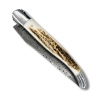
French cutlery tradition elevated by Damascus steel and masterful craftsmanship
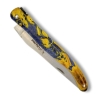
Exclusive Laguiole Knives: One-of-a-Kind Masterpieces
Where French Heritage Meets Everyday Utility
Sheaths, Box & Belt Pouches
LAGUIOLE CORKSCREWS
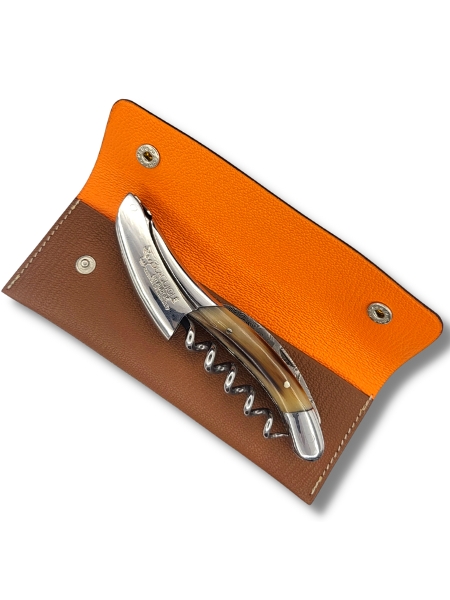
Discover our range of Laguiole en Aubrac sommelier corkscrews, essential accessories for wine lovers and oenology professionals. Each corkscrew is crafted with the same care and quality standards as the famous Laguiole en Aubrac knives.
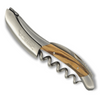
Marquetry - Wood - Horn or Bone
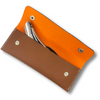
Leather Sheaths
FREE LASER ENGRAVING
Choosing a personalized Laguiole en Aubrac sommelier corkscrew means adding a touch of originality to an object already known for its quality and aesthetics!
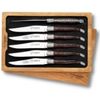
LAGUIOLE CUTLERY SETS
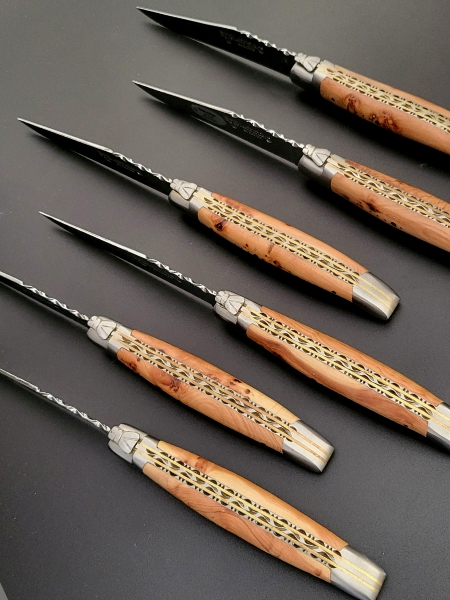
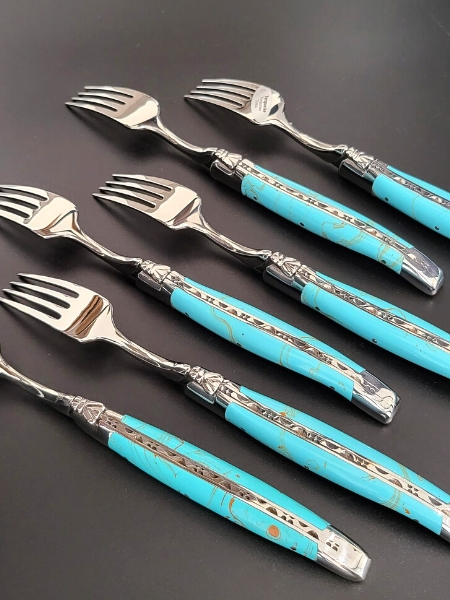
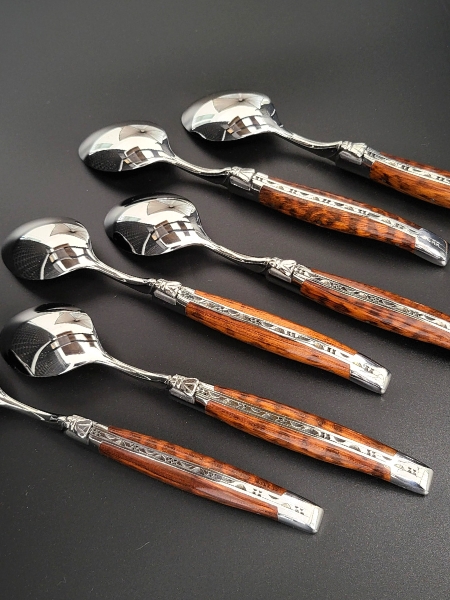
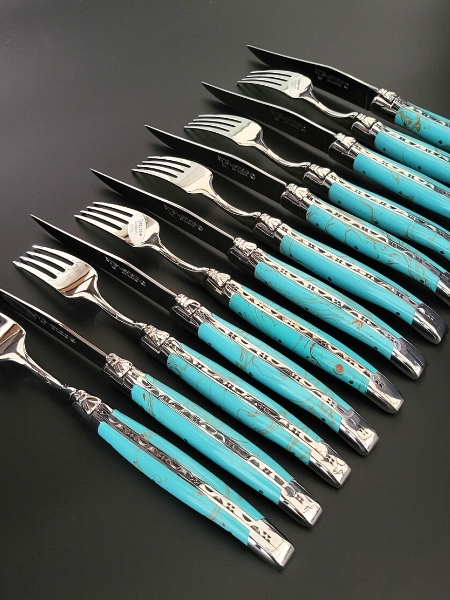
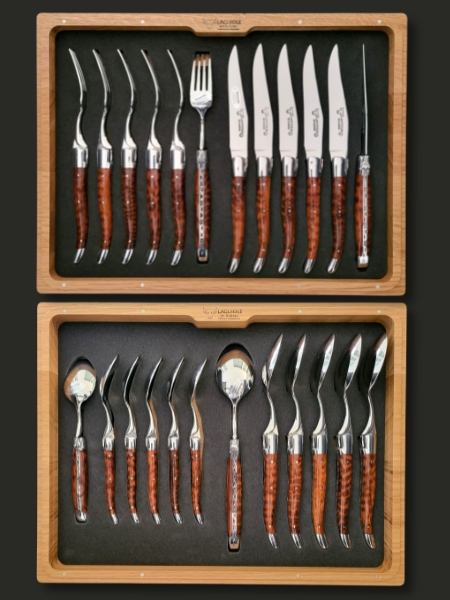
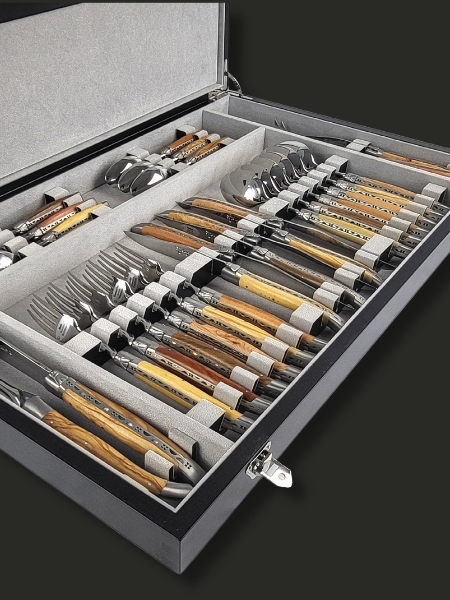
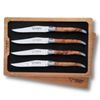
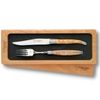
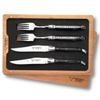
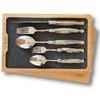
Our selection of Laguiole en Aubrac cutlery offers a range of choices from classic to modern models, featuring various colors and original handle materials. Available in sets of 2, 4, or 6, with or without forks, as well as soup and dessert spoons. Not to mention the famous table sets.
Various handle materials
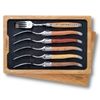
Various handle materials
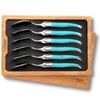
Various handle materials
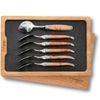
Various handle materials
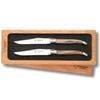
Various handle materials
Various handle materials
Various handle materials
Various handle materials
Various handle materials
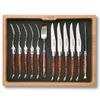
Various handle materials
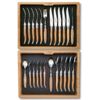
Various handle materials
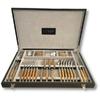
Various handle materials
Additional Knives and Sets
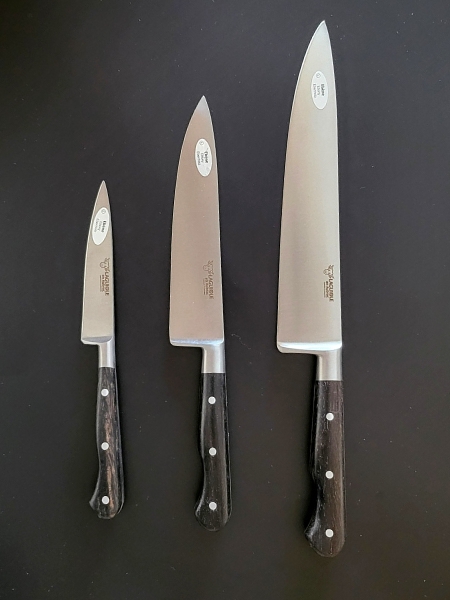
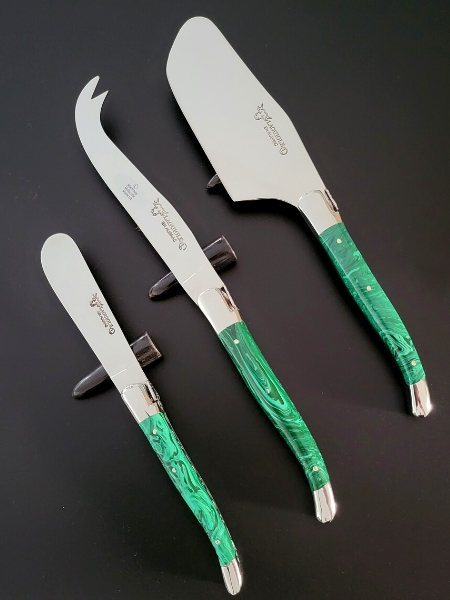
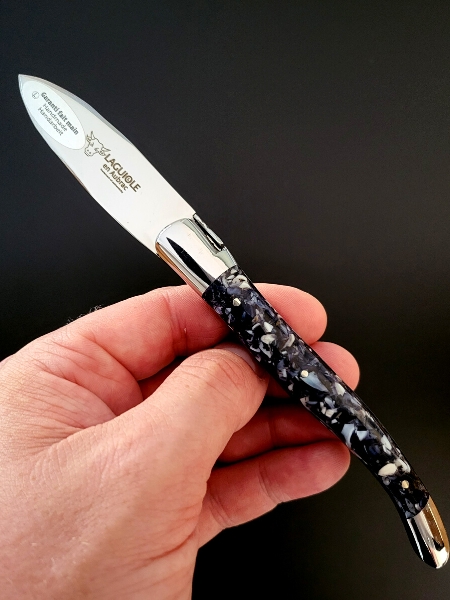
Discover the complementary cutlery range, designed to enhance your meals and offer you an unparalleled culinary experience. This refined and elegant collection includes cheese knives, oyster knives, carving sets, and many other essential accessories for a carefully set table.
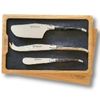
Individuals or in sets x3
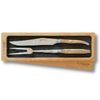
Various handle materials
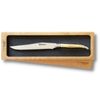
Various handle materials

Various handle materials
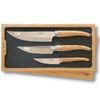
Individuals or in sets x3
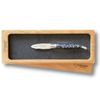
Recycled seashell handles
Various handle materials
Various handle materials