
All Laguiole folding knives
Laguiole knives with corkscrew
989€
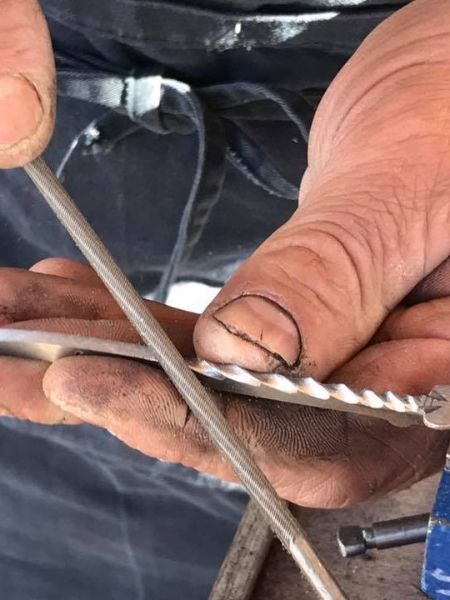
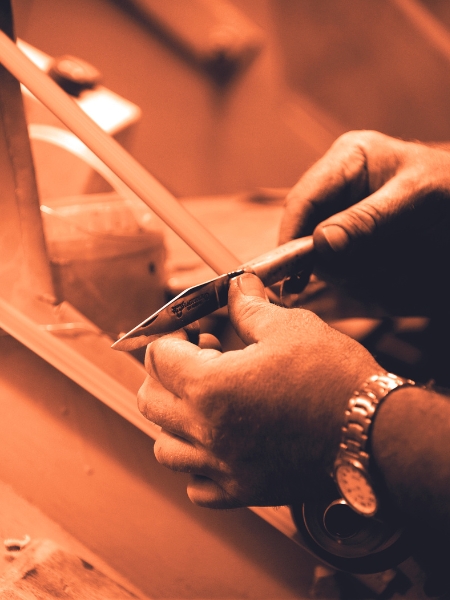
The Striped Elven Queen Laguiole knife is a one-of-a-kind piece, entirely hand-crafted by the most accomplished cutlers at the Laguiole en Aubrac workshop. Its handle, made from green and brown plane wood, has been prepared to highlight the dialogue between the two tones. The stripes that mirror each other along the backspring create a strong yet harmonious visual effect, as though the wood had been woven around an invisible axis.
A black liner slipped between the wood and the liners underlines this architecture, reinforcing the graphic personality of the piece while adding a crisp, elegant contrast.
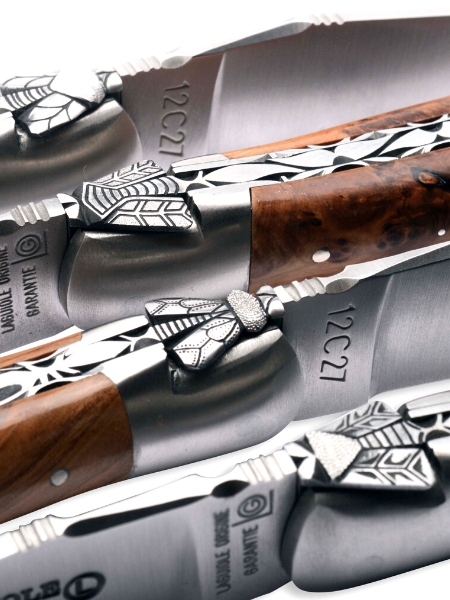
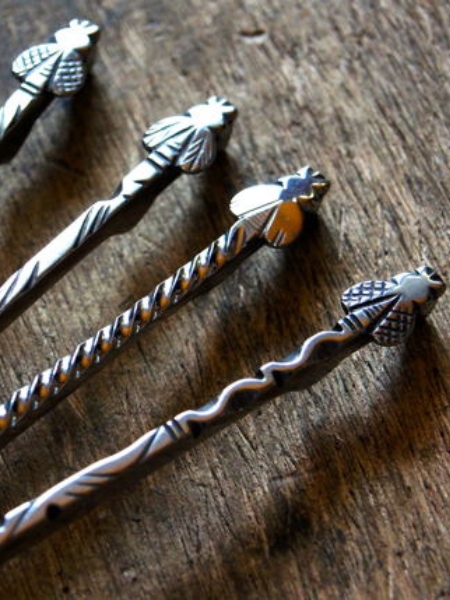
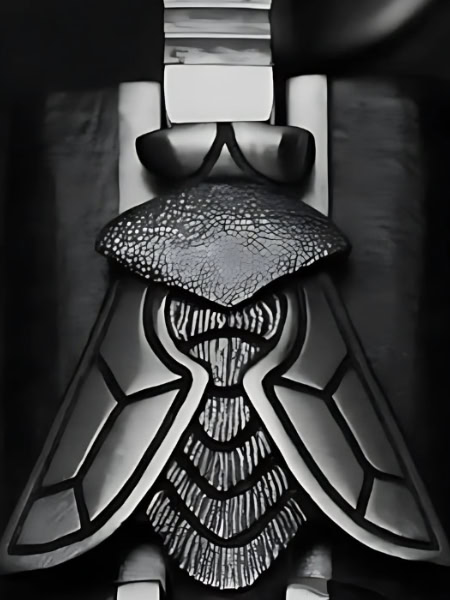
The bee stands out through its volume and the richness of its chiselling. Solid and imposing, its entire body is covered with carefully repeated ovoid patterns, calling to mind both clockwork gears and decoration with an elven flair. Its broad, long wings fall like a dress, enhancing the impression of a protective, almost maternal figure. The bee thus gains a powerful, immediately recognisable presence.
The backspring features guilloché work that alternates engraved lines with fine hammered dots. These graphic motifs, both regular and subtly vibrating, extend across the full length of the spring. They are echoed on all four faces of the bolsters, creating a decorative rhythm that encircles the knife, even on surfaces the eye does not always notice at first.

The blade finishes with a pattern of linear engraving, in direct dialogue with the work on the spring and the bee.
The Striped Elven Queen speaks to Laguiole enthusiasts who seek a knife with real character, standing at the crossroads between classic tradition and a more fantastical universe. The striped plane wood, the black liner, the mother-bee figure and the graphic motifs on spring, bolsters and blade form a coherent, powerful composition, created as much for visual pleasure as for the pleasure of use.
1 in stock


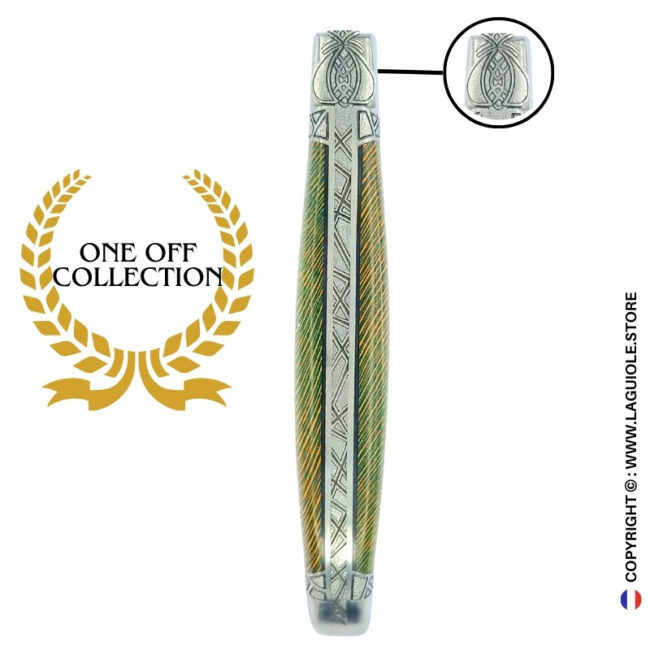
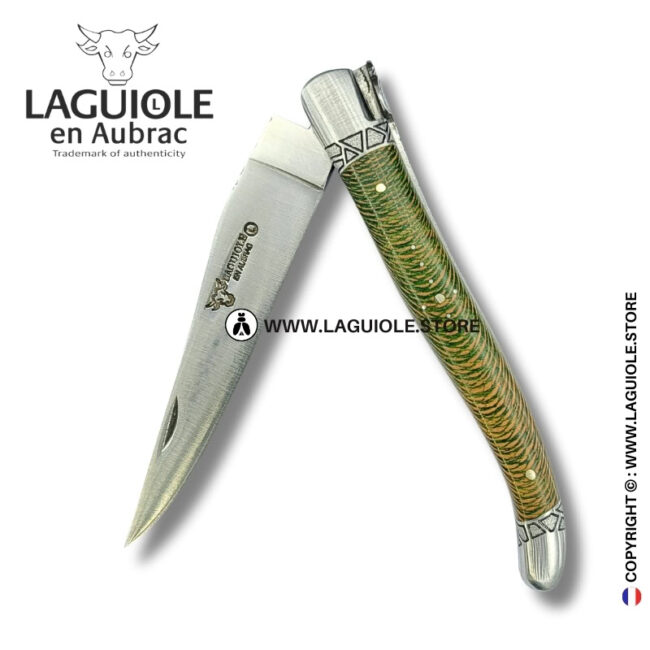
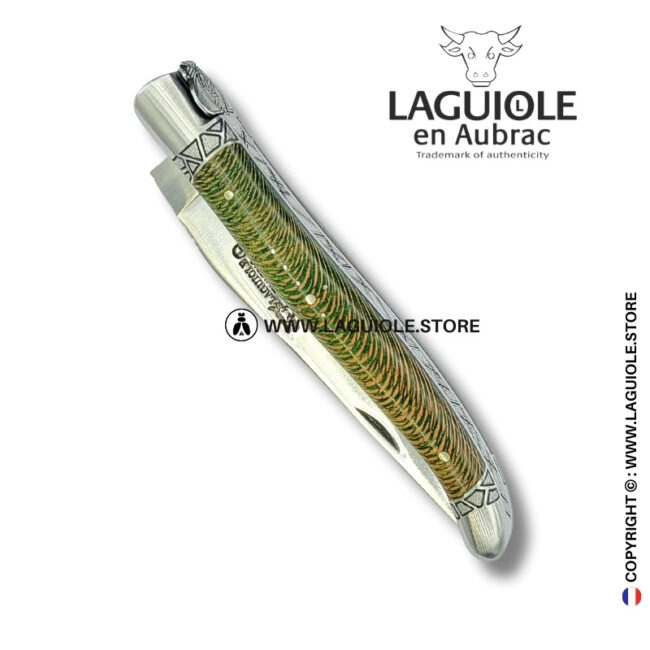
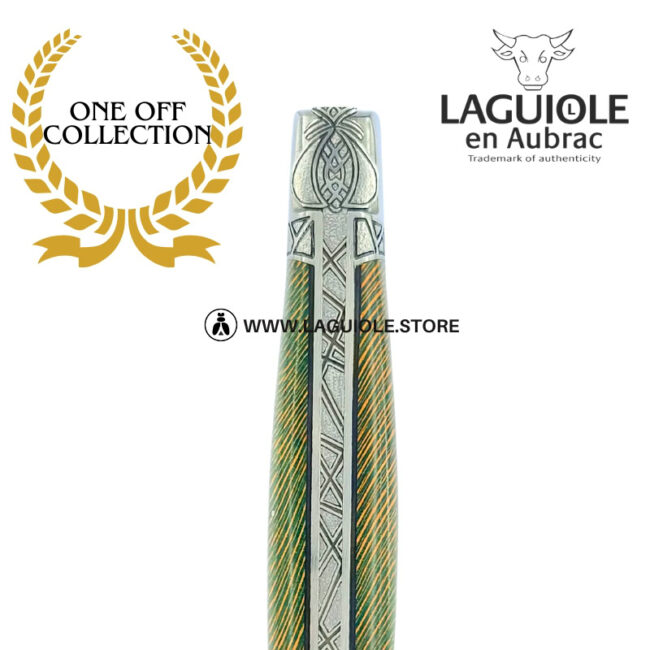
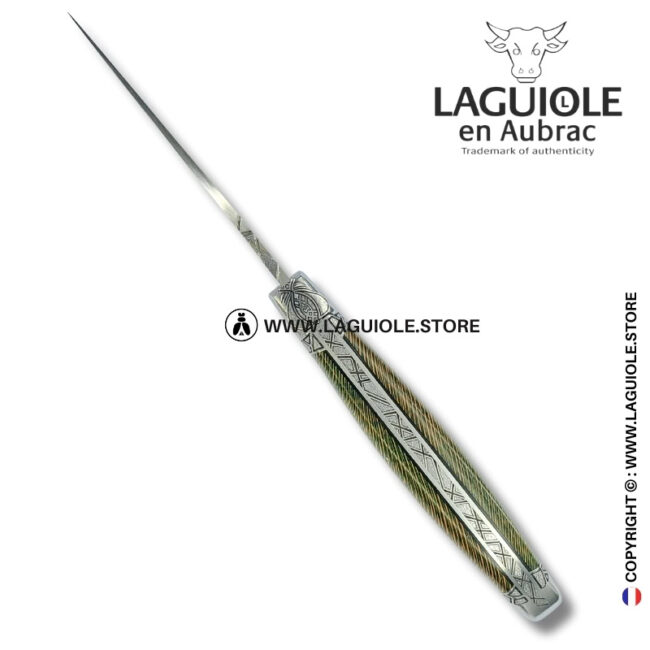
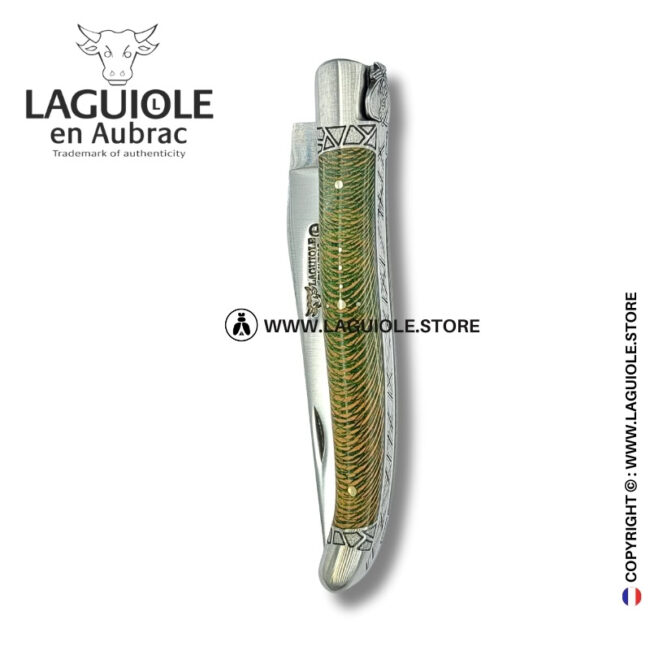
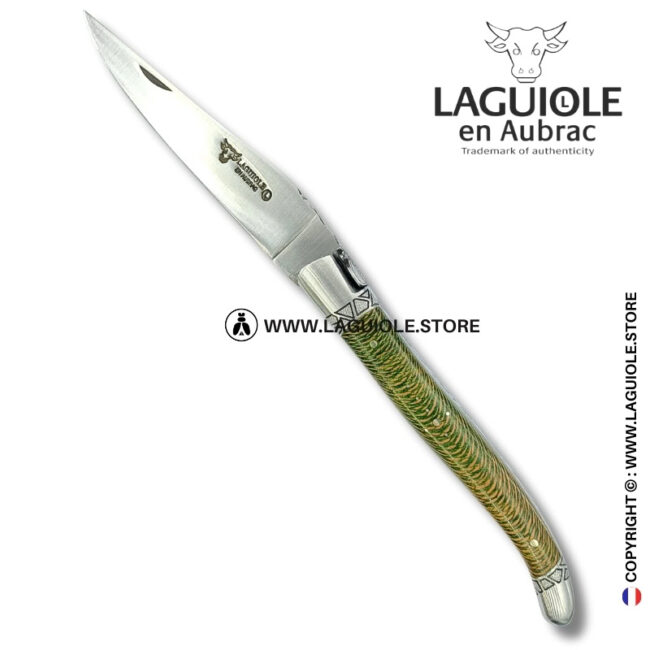
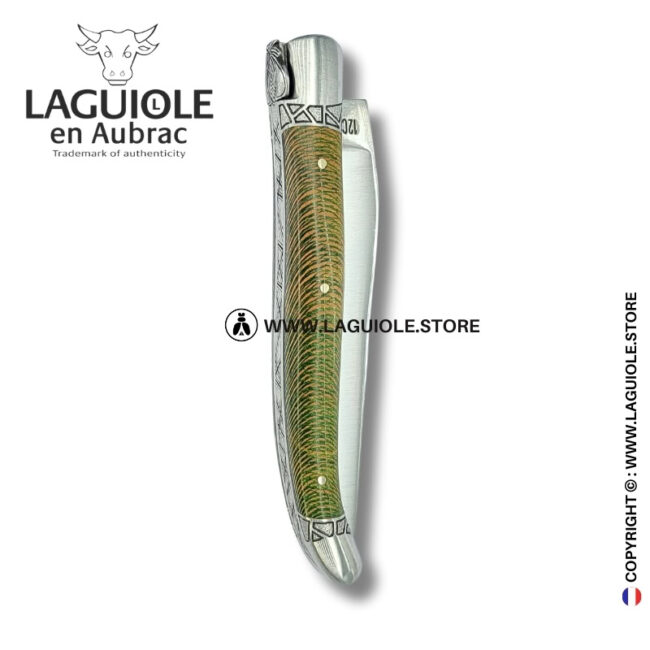
“Striped Elven Queen” feels like a Laguiole that has wandered in from the edge of an enchanted forest. Its handle in green and brown plane wood has been cut so the grain runs from one side of the backspring to the other, drawing true natural stripes across the knife. The colours blend like bark shot through with sap, while a slim black liner traces the outline of the knife like a fine shadow, giving the wood even more depth and presence.
At the top, the bee – solid and protective – is dressed in an oval pattern of engravings that calls to mind an elven-style gear, while her long wings fall like a sculpted metal gown along the spine. The spring and bolsters echo this graphic language, alternating engraved lines and fine point hammering on every face, right down to the motifs that appear as the final accent on the blade itself.
“Striped Elven Queen” is a characterful Laguiole, standing at the crossroads of Laguiole tradition and fantasy-inspired design – made for those who love knives they can admire as much as they use.

The Striped Elven Queen feels like a knife born on the edge of a forest, where trees give way to an older, hidden realm. The plane wood has been cut with intention: its green and brown veins stripe the handle like markings on a pelt, answering each other on either side of the backspring, as if one continuous line of sap were running from end to end. The wood creates a kind of vegetal fur, wild in spirit yet perfectly under control.
Between wood and steel, a black liner draws a dark, discreet thread – a shadow line that traces the outline without ever demanding the spotlight.
At the top, the bee rules like a queen. Broad and substantial, she has the presence of a nurturing mother, guardian of an invisible hive. Her wings are wide and long, almost like a gown draped over her flanks. From head to tail, her body is covered in ovoid engravings that interlock like the teeth of a graphic, elven-looking gear. It reads like an ancient script, a constellation of signs whose meaning only a few rare minds might still hold.
The backspring carries this language in steel. Alternating taut lines and tiny hammered points, it unfolds a series of motifs that hover somewhere between structure and vibration. The same signs reappear on all four faces of the bolsters, as if the knife were wrapped in a continuous frieze. Even the blade is not left bare: it ends with a final echo of those graphic lines, the closing sentence of a silent text.
The Striped Elven Queen is not a knife you take in with a single glance. You read it, follow it with your eyes, slowly decipher it – like a relic from a world where wood, metal and light once spoke the same language.

Green and brown striped plane wood is a visually striking timber, chosen for the strength of its contrasts and the dynamic flow of its grain. Thanks to the way it is cut, green and brown tones cross and answer each other from one side of the handle to the other, as if a single line of sap were running straight through the knife. The result suggests a kind of vegetal coat – wild in spirit yet perfectly ordered.
These natural stripes create a highly graphic play of lines: some bands seem to wrap around the wood, while others break into more irregular bursts. Every piece of green and brown striped plane wood has its own pattern, giving each knife a strong visual identity – ideal for a statement piece like the “Striped Elven Queen.” A satin polish softens the feel in the hand without blurring the grain, so the handle remains both comfortable to hold and intensely expressive to the eye.


Leather Sheaths & Sharpener


Leather Sheaths & Sharpener

Leather Sheaths & Sharpener


Leather Sheaths & Sharpener


Leather Sheaths & Sharpener


• Made in France, in the historic area of origin.
• Engraving and shipping carried out on the day of the order.
• Deliveries to France, European Union, and internationally.
• Delivery within 48h in EU. 4 days to USA with DHL Express.
• Provided with: certificate of authenticity, 14 page manual of genuine Laguiole knives, protective case.
FREE LASER ENGRAVING
Laser engraving on the blade is an innovative technique that combines art and technology to enhance and personalize a knife. Choose from 6 fonts and 12 symbols.
Laguiole FOLDING KNIVES
Discover our selection of Laguiole en Aubrac folding knives, a staple of French artisanal cutlery. These high-quality pocket knives, combining elegance and practicality, are the result of traditional craftsmanship and unique expertise in knife making.
All Laguiole Folding Knives
Our models without corkscrew
Stainless Steel or Brass Bolsters
Shiny or Mat finish
With or Without Corkscrew
With or Without Corkscrew
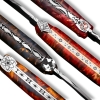
This exclusive collection from Laguiole en Aubrac showcases exquisite pocket knives that epitomize the art of fine cutlery.
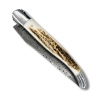
French cutlery tradition elevated by Damascus steel and masterful craftsmanship
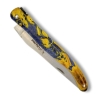
Exclusive Laguiole Knives: One-of-a-Kind Masterpieces
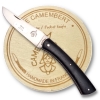
Where French Heritage Meets Everyday Utility
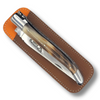
Sheaths, Box & Belt Pouches
LAGUIOLE CORKSCREWS
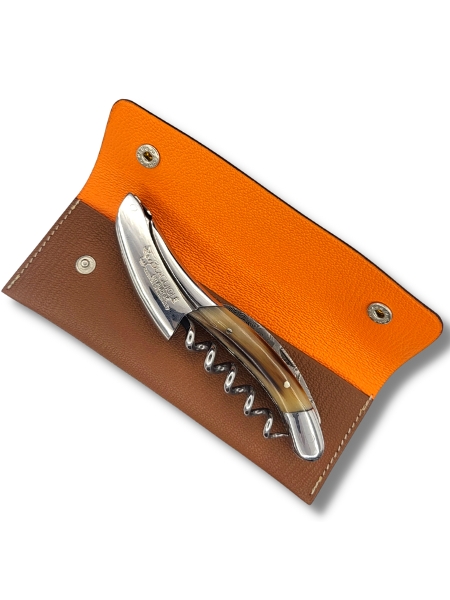
Discover our range of Laguiole en Aubrac sommelier corkscrews, essential accessories for wine lovers and oenology professionals. Each corkscrew is crafted with the same care and quality standards as the famous Laguiole en Aubrac knives.
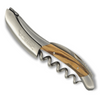
Marquetry - Wood - Horn or Bone
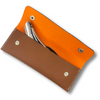
Leather Sheaths
FREE LASER ENGRAVING
Choosing a personalized Laguiole en Aubrac sommelier corkscrew means adding a touch of originality to an object already known for its quality and aesthetics!

LAGUIOLE CUTLERY SETS
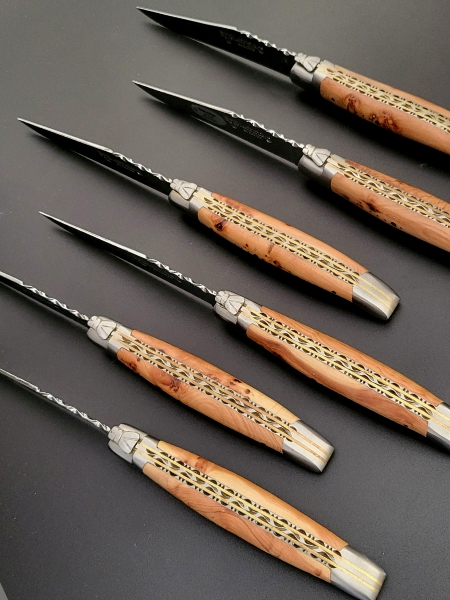
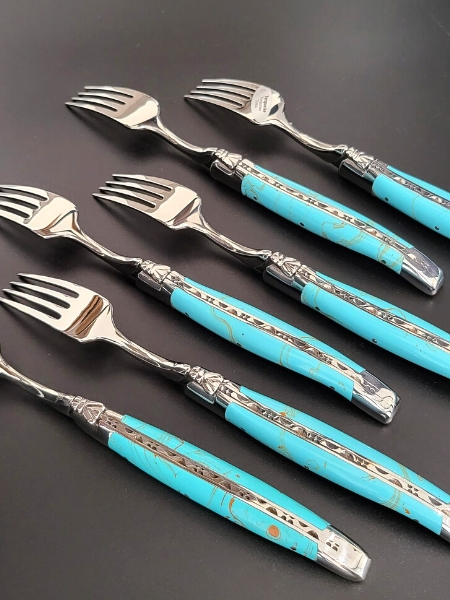
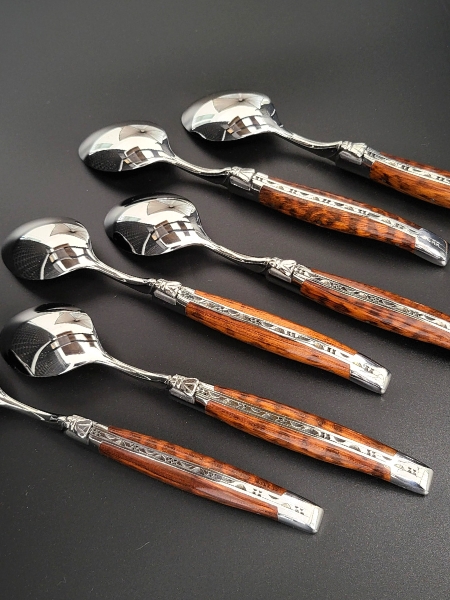
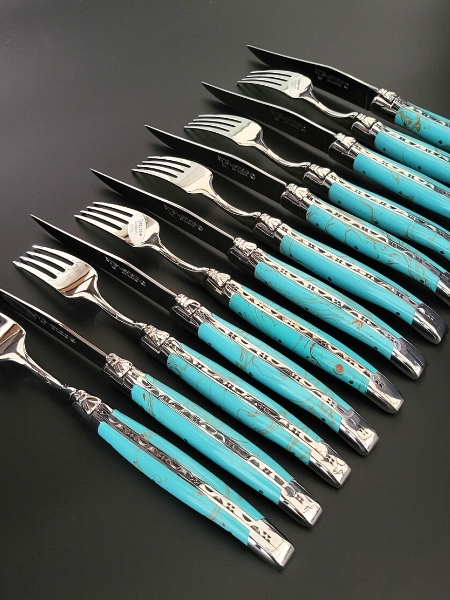
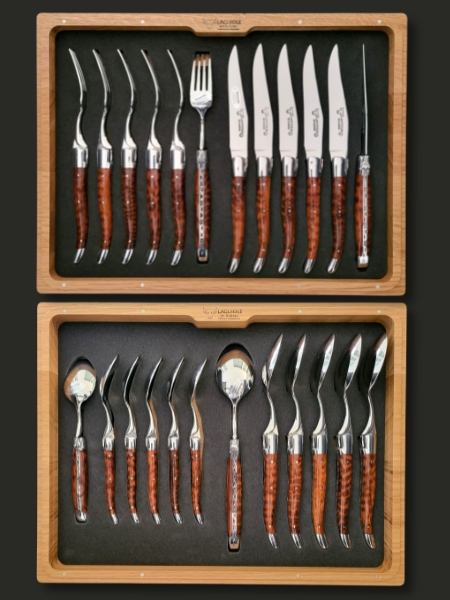
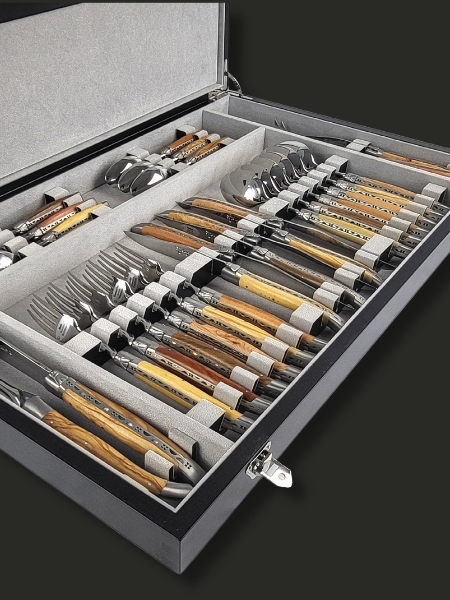
Our selection of Laguiole en Aubrac cutlery offers a range of choices from classic to modern models, featuring various colors and original handle materials. Available in sets of 2, 4, or 6, with or without forks, as well as soup and dessert spoons. Not to mention the famous table sets.
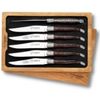
Various handle materials
Various handle materials
Various handle materials
Various handle materials
Various handle materials
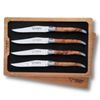
Various handle materials
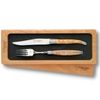
Various handle materials
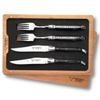
Various handle materials
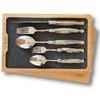
Various handle materials
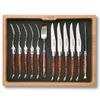
Various handle materials
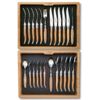
Various handle materials
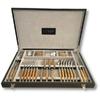
Various handle materials
Additional Knives and Sets
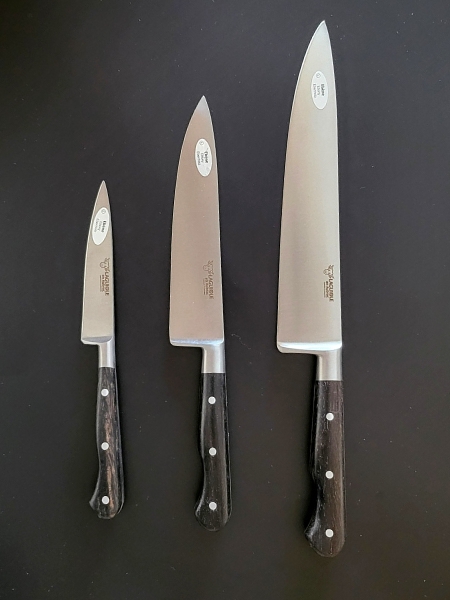
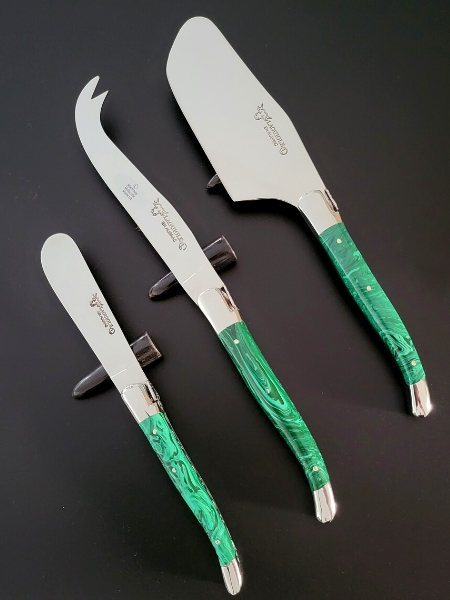
Discover the complementary cutlery range, designed to enhance your meals and offer you an unparalleled culinary experience. This refined and elegant collection includes cheese knives, oyster knives, carving sets, and many other essential accessories for a carefully set table.
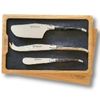
Individuals or in sets x3
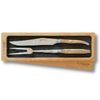
Various handle materials
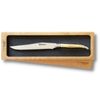
Various handle materials

Various handle materials
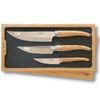
Individuals or in sets x3
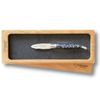
Recycled seashell handles
Various handle materials
Various handle materials